


Réseau: RAFAQUA
What Contribution Can Aquaculture Make to Inclusive Growth, Sustainable Development and Job Creation in Africa?
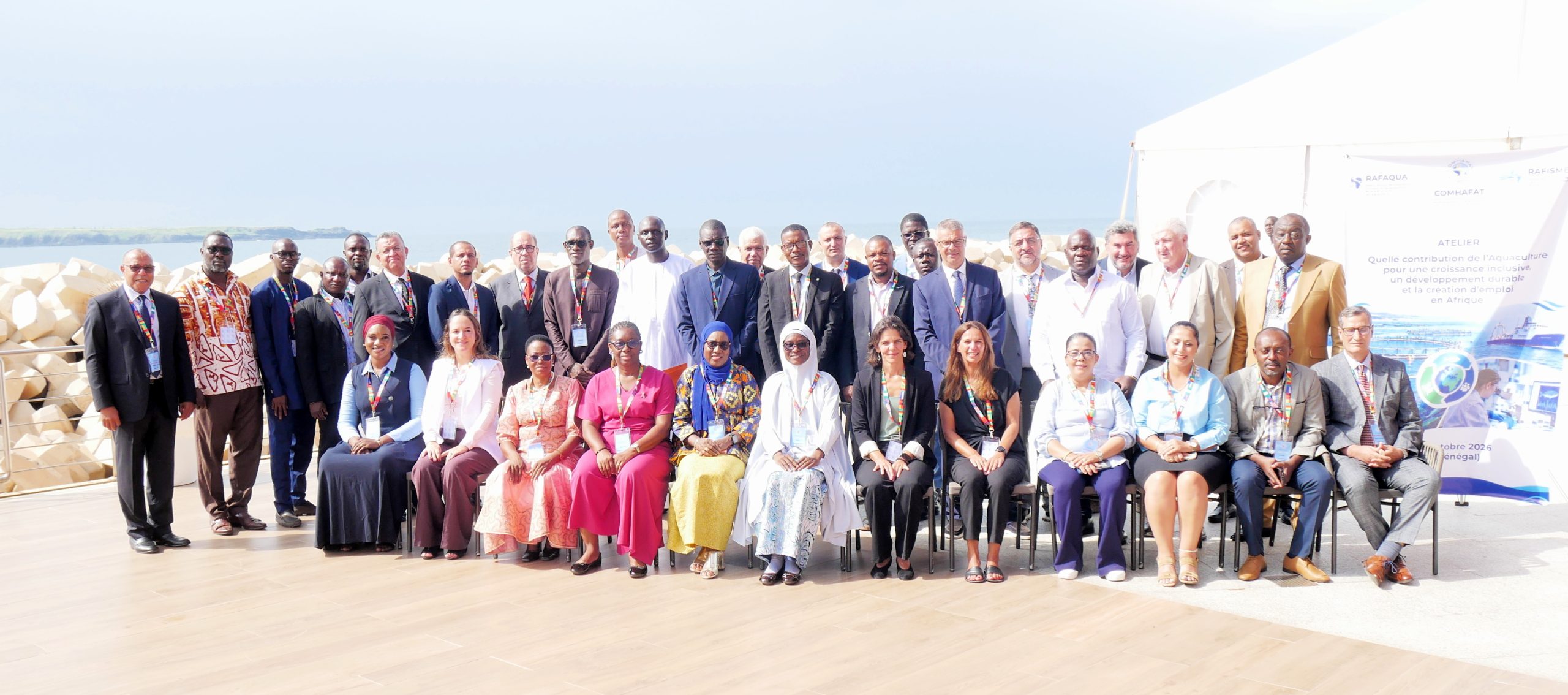
Aquaculture: Dakar unites African stakeholders around a common ambition.
On October 7 and 8, 2026, Dakar brought together African aquaculture stakeholders around a common goal: to make the sector a lever for food security, employment and sustainable development.
The Senegalese capital hosted a high-level meeting on October 7 and 8, 2026, dedicated to the future of aquaculture in Africa. Organized jointly by the African Network of Institutions Responsible for the Development and Promotion of Aquaculture (RAFAQUA) and the African Network of Fisheries Research Institutes and Marine Sciences (RAFISMER), with the support of the Ministerial Conference on Fisheries Cooperation among African States Bordering the Atlantic Ocean (ATLAFCO), the meeting's theme was: "What Contribution Can Aquaculture Make to Inclusive Growth, Sustainable Development, and Job Creation in Africa?"
The meeting brought together representatives from the 22 member states of ATLAFCO, as well as representatives from the Sub-Regional Fisheries Commission (SRFC), the Portuguese Air Centre, and the OMPDA. It provided an opportunity to share experiences, compare approaches, and identify avenues for cooperation to accelerate the development of sustainable and successful aquaculture in Africa.
In a context marked by declining fish catches, increasing pressure on fishery resources and population growth, aquaculture appears as a strategic sector to meet the food and socio-economic needs of populations.
In his opening address, Mr. Baba Ndiaye, Chief of Staff to the Minister of Fisheries and Maritime Economy of Senegal, expressed his delight at the holding of this meeting in Senegal. He emphasized not only the importance of aquaculture's potential in terms of food security, job creation, and income generation, but also in the fight against illegal immigration.
“Aquaculture is now emerging as a credible alternative”, he said, calling for an acceleration of the transition from capture fisheries to aquaculture. This shift, he believes, should enable Africa to better address the food and economic challenges it faces.
According to Mohamed Najih, President of RAFISMER, this transition cannot succeed without the mobilization of all stakeholders. "The success of this transition requires a break with isolated approaches. We need strong synergy between political decision-makers, research institutes, the private sector, and our development partners", he stated.
He specifically called for strengthening investment security, organizing production zones, and modernizing the infrastructure necessary for the development of the sector.
The President of RAFAQUA, Mr. Samba Ka, also stressed the need for collective action across the continent. "We are obliged to work together and find sustainable solutions," he stated.
At the close of the proceedings, the Executive Secretary of ATLAFCO, Mr. Taoufik El Ktiri, commended the quality of the presentations and discussions. He noted that they reflected a shared commitment to building a sustainable, competitive, profitable, and equitable African aquaculture sector.
The Dakar meeting thus strengthened dialogue between states, research institutions, industry stakeholders, and development partners. It also confirmed the need to align public policies, research, and private initiatives to empower aquaculture to fully contribute to the continent's development.
For ATLAFCO, this dynamic aligns with its mission to strengthen cooperation among its member states and promote the sustainable management of fisheries resources. The development of aquaculture is, in this respect, a key area for diversifying the sector's activities, strengthening food security, and supporting the economies of coastal communities.
Through RAFAQUA and RAFISMER, ATLAFCO intends to continue this momentum by promoting knowledge sharing, the exchange of experiences, and the networking of African expertise. The objective is to bring decision-makers, researchers, professionals, and partners closer together in order to develop common solutions to the sector's challenges.
Through this workshop, ATLAFCO reaffirms its commitment to supporting its member states in this endeavor and to leveraging regional cooperation as a key driver of action. The ambition is to contribute to the emergence of a more sustainable, competitive, and inclusive African aquaculture sector, serving food security, employment, and the continent's sustainable development.
Proceedings of the second (2nd) Ordinary General Meeting of the African Network of Institutions in charge of the Development and Promotion of Aquaculture – RAFAQUA

Food Security through Aquaculture: Sustainability and Regional Synergies
